
Electric retrofit for Vespa allows you to ride your classic Vespa on the road with an electric motor, without sacrificing the chassis, lines, and heritage of the original vehicle, while keeping maintenance to a absolute minimum.
Before buying a kit, however, it pays to understand three key points: how the conversion actually works, how much it costs, and what is required to ride legally on the road. In this guide, we answer all three.
What is electric retrofit?
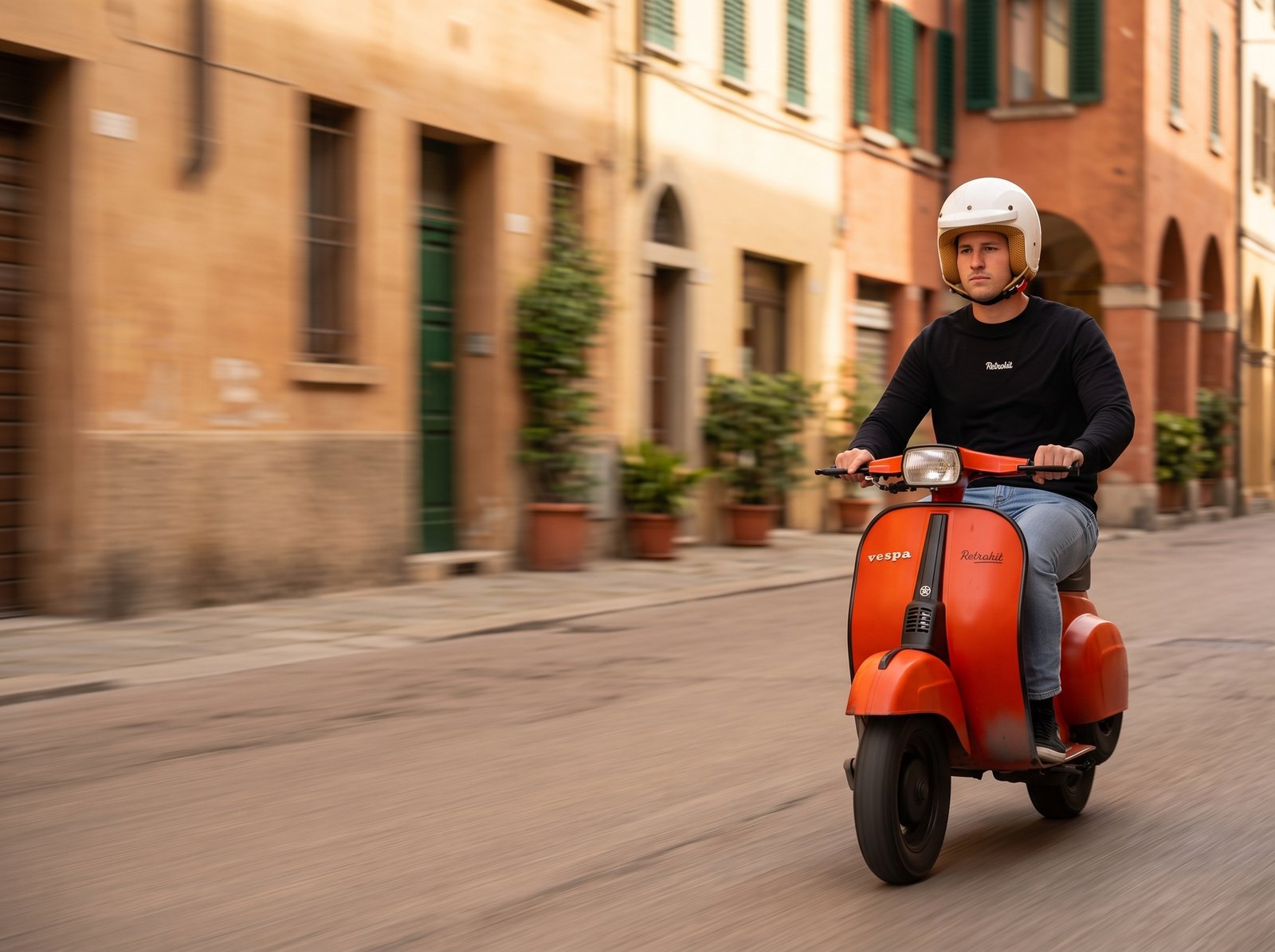
Electric retrofit is the conversion of an internal combustion engine vehicle into an electric vehicle. The internal combustion engine is removed and replaced with an electric motor, battery, and control unit—all while retaining the original frame to preserve the aesthetic and historic value of the vehicle.
Mid-drive motor vs. hub motor: what’s the difference?
Online, you can find two main types of conversion kits:
- Hub motor (motor in the wheel): the motor is housed inside the rear wheel rim. It is the cheapest solution, but it alters the original wheel and often requires structural adaptations to the frame.
- Motor replacing the original engine block: the electric motor takes the place of the internal combustion engine, mounting in the exact same spot using the same engine mounts. This solution requires precise engineering tailored to fit the chassis seamlessly.
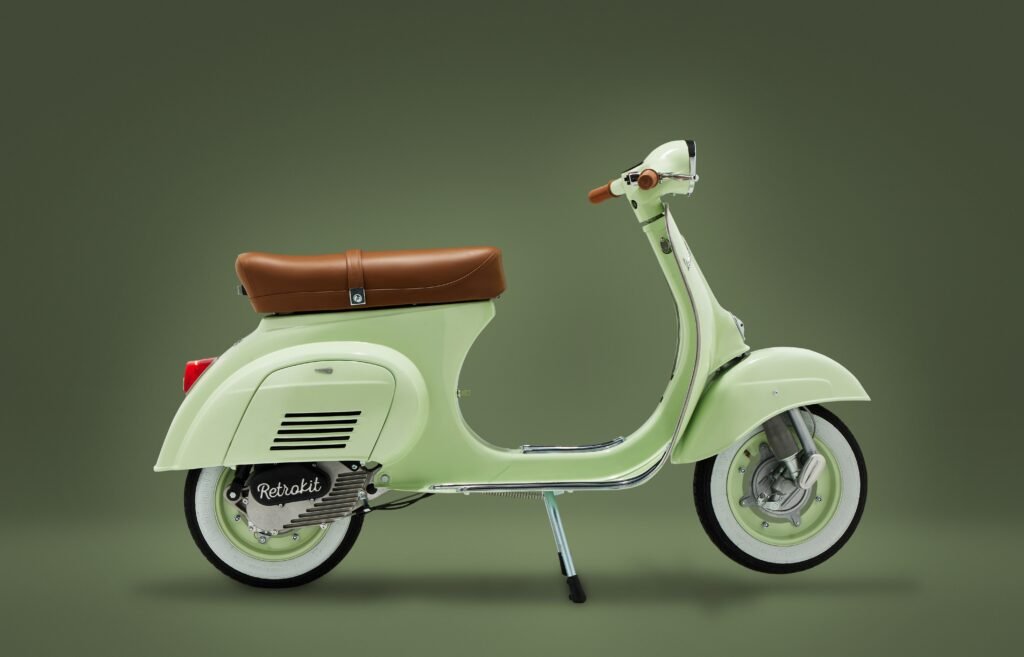
Retrokit takes this second approach. The casing mounts directly to the frame and rear shock absorber, just like the original engine. The wheels remain your Vespa’s originals, and the frame is never cut or welded. Because of this, the conversion is technically fully reversible—though road regulations in Italy currently do not permit switching back to an internal combustion engine, unlike in countries such as Germany.
Type-approved vs. non-homologated conversion kits: the risks
On online marketplaces and foreign websites, low-cost conversion kits are common. The main issue is that they are almost never type-approved (homologated) for street-legal use, which leads to serious legal and safety liabilities. Installing a non-homologated kit means riding a vehicle that no longer matches its official registration document. The potential consequences include:
- Heavy fines and revocation of the vehicle registration document;
- Vehicle impoundment;
- Insurance refusal to cover damages in the event of an accident;
- No safety guarantees or warranty on the battery, controller, or electrical system.
How to recognize a street-legal conversion kit
- The manufacturer clearly states road-legal type approval and lists the compatible models.
- The kit includes all necessary documentation to update the vehicle logbook.
- The manufacturer explains the homologation process clearly and provides dedicated customer support.
Retrokit is a fully road-legal, type-approved electric conversion kit designed and manufactured in Italy. As a result, the conversion can be officially registered at the vehicle licensing authority.
How much does a Vespa electric retrofit cost?
The price depends on your Vespa frame size and the level of performance you want. Retrokit offers two conversion kit options:
| Kit | Compatible Vespa Models | Price |
|---|---|---|
| Sport | Smallframe: Vespa 50, Primavera 125, ET3 125, PK | from € 4.150 + VAT |
| Large | Wideframe & Largeframe: PX, GS, GL, and others | from € 5.160 + VAT |
What is included in the price?
Every kit includes the complete electric motor with aluminium casing, 72V battery pack (two battery modules on the Large kit), controller, digital display, LED headlight system, smartphone USB charging port, Connectivity Pack with dedicated mobile app, and a 2-year warranty. Free shipping is included.
Electric retrofit, petrol restoration, or a new electric scooter?
| Retrokit Retrofit | Petrol Engine Restoration | New Electric Scooter | |
|---|---|---|---|
| Original bodywork & classic lines | Yes | Yes | No |
| Low-emission zones & city access | Yes, as a zero-emission electric vehicle | Subject to local traffic restrictions | Yes |
| Fuel source | None (plugs into standard socket) | Petrol / 2-stroke mix | None |
| Engine maintenance | Minimal | Carburettor, spark plugs, clutch | Minimal |
| Classic value & vintage charm | Preserved | Preserved | None |
An electric retrofit requires a higher initial investment than a basic engine overhaul, but it permanently eliminates fuel costs and engine maintenance. Compared to buying a modern electric scooter, it allows you to ride an authentic, classic Vespa.
How road-legal approval and registration work
To legally ride a converted Vespa on public roads, you need a type-approved conversion kit and an update to your vehicle registration document reflecting the electric powertrain switch. Without updating the vehicle logbook, the scooter is not street-legal, even if the kit itself meets all manufacturing standards.
Retrokit guides you through the entire registration procedure. If you want to know all the details regarding paper documentation, check out our dedicated article: Do you need to re-register your classic Vespa after electric conversion?
Which Vespa models can be converted to electric?
Retrokit is engineered specifically for vintage Vespa frames and is available in two main configurations:
- Smallframe (Sport kit): Vespa 50 Special, 50 Faro Tondo, Primavera 125, ET3 125, and all PK models.
- Wideframe & Largeframe (Large kit): PX, GS, GL, and other large-body models.
Not sure if your model is compatible? Find the full list on our Vespa electric conversion kit page, or reach out to our team directly for a compatibility check.
Range, performance, and battery charging
An electric Vespa fitted with Retrokit delivers superior acceleration compared to the original, thanks to the instant torque of the electric motor.
| Kit | Peak Power | Torque | Top Speed | 0–50 km/h | Range |
|---|---|---|---|---|---|
| Sport (geared) | 7.2 kW | 120 Nm | 80 km/h | 4 s | 80 km |
| Large (geared) | 13 kW | 160 Nm | 110 km/h | 2 s | 130 km |
Estimated battery range is based on urban riding cycles and varies according to rider weight, route topography, and riding style.
How to charge the battery
- Onboard charging: connect the charger directly to the scooter while the battery remains in the under-seat compartment, using any standard wall outlet.
- Removable battery: easily remove the battery pack and charge it wherever convenient—at home, in the office, or at a café.
A complete charge from 0% to 100% takes approximately 4 hours, though full discharges are not required before topping up.
Frequently asked questions about Vespa electric retrofit
Is the electric conversion reversible?
The conversion is non-destructive and technically fully reversible. However, Italian vehicle regulations currently prohibit reverting back to a petrol engine, unlike in countries such as Germany where re-registering an internal combustion engine remains optionable.
Do I need a new license plate or registration document?
Your original license plate remains the same. The vehicle registration document must be updated to record the electric conversion: learn more in our detailed homologation guide.
What is the battery range?
On a single charge, you can achieve up to 80 km of urban range with the Sport kit and up to 130 km with the Large kit.
Can I install the conversion kit myself?
The Retrokit is a plug-and-play solution requiring no cutting, drilling, or welding. Anyone with basic mechanical skills and standard hand tools can complete the installation in a few hours by following our step-by-step video guide. However, to update the vehicle registration document, certification signed by a registered mechanic is required by law.
